

How Much Power Does a 1.5 Ton AC Need?
A 1.5 ton AC typically has a running load of 1,500 to 1,800 watts. The exact figure depends on whether it’s a standard AC or a 5-star inverter-technology AC (the energy-efficient kind, not to be confused with the power inverter you’re buying). At startup, the compressor draws a surge that can be considerably higher than the running wattage for a second or two.
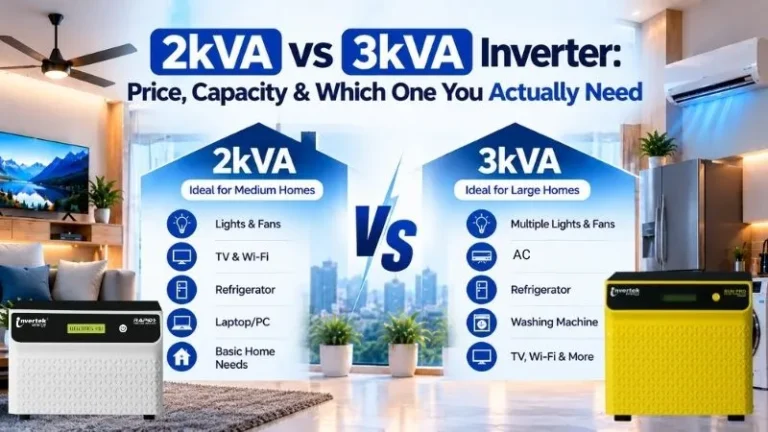
Because of this surge, you need an inverter rated well above the AC’s running wattage, not just matched to it. If you’re comparing smaller options, our guide to 2kVA vs 3kVA inverters shows where each one stops being enough.
What Size Inverter for AC 1.5 Ton Do You Need?
| AC Type | Recommended Inverter Capacity |
|---|---|
| Standard (non-inverter) 1.5 ton AC | 3.5 kVA to 5 kVA |
| Inverter-technology 1.5 ton AC (5-star) | 3 kVA to 4 kVA |
Inverter-technology ACs adjust compressor speed instead of switching fully on and off. This gives them a gentler startup surge, so they can often run on a slightly smaller inverter than a standard AC of the same tonnage. Always check the starting and running current on your AC’s nameplate before finalizing your size.
Whichever capacity you choose, go for a pure sine wave inverter. Compressors run smoother and cooler on a clean waveform, which protects your AC over the long term.
Price of an Inverter for 1.5 Ton AC
| Component | Typical Price Range |
|---|---|
| 3.5-4 kVA inverter (24V/48V, pure sine wave) | ₹22,000 – ₹32,000 |
| Batteries (2-4 units, depending on voltage) | ₹20,000 – ₹45,000 |
| Total setup (inverter + batteries) | ₹42,000 – ₹75,000 |
This is a bigger investment than a standard home inverter setup, so calculate your needs carefully rather than guessing.
Why Undersizing Is a Costly Mistake
Many buyers pick a smaller inverter to save money and hope it can “just about” run the AC. This usually backfires in one of two ways:
- The inverter trips repeatedly when the compressor starts.
- The AC runs, but the battery drains so fast that backup time becomes impractical, often under 30-45 minutes.
Before buying, use the approach in our guide on how to calculate your inverter battery backup time. Pay special attention to the AC’s starting current, not just its running wattage, since that surge is what typically trips undersized inverters.
Battery Requirements for AC Backup
An AC drains batteries much faster than lights and fans. For even 1-2 hours of AC backup, you’ll likely need:
- A higher voltage system (36V or 48V rather than 12V or 24V)
- Multiple batteries rated 150Ah or higher each
- A fast-charging inverter, so batteries recover quickly between outages
A lithium-ion battery is worth considering, since it can be discharged much deeper than lead acid and gives you more usable backup from the same stated capacity.
Because of the cost, many buyers run the AC at a lower fan speed during backup, or size the system to keep the room comfortable rather than at full cooling. If you run more than one AC, or want long backup for a large home, look at a high capacity UPS built for heavy loads.
Checklist: What to Check Before You Buy
- Confirm the AC’s exact starting and running current from its nameplate or manual.
- Choose an inverter with comfortable headroom above the starting current, not just the running wattage.
- Match the battery bank voltage to the inverter’s requirement (24V, 36V or 48V).
- Ask the dealer to confirm compatibility with your specific AC model.
- Compare the total system price (inverter + full battery bank), not just the inverter cost.
Final Thoughts
Running a 1.5 ton AC on backup is possible, but only with a properly sized system. Get both the inverter capacity and the battery bank right, or you’ll end up with a setup that trips constantly or drains too fast to be useful. Work out your AC’s actual power draw first, then choose the right inverter for AC 1.5 ton use around that number rather than around your budget alone.
👉 Size your inverter for AC backup correctly the first time with our UPS Finder tool.
Frequently Asked Questions
1. Can a 2kVA inverter run a 1.5 ton AC?
Generally no. Most 1.5 ton ACs need at least 3-3.5 kVA because of the compressor startup surge, though inverter-technology ACs may need slightly less. See our 2kVA vs 3kVA comparison for details.
2. Does an inverter-technology AC need a smaller power inverter?
Often yes, since its startup surge is gentler than a standard AC of the same tonnage. Still, always check the exact nameplate specifications.
3. How long can I run an AC on inverter backup?
It depends heavily on your battery bank size. A modest setup gives roughly 1-2 hours, and larger banks extend this at a higher upfront cost.
4. What voltage system is best for running an AC?
36V or 48V systems are generally recommended, since they let the inverter draw current more efficiently across multiple batteries.
5. Is a generator cheaper than an inverter for running an AC?
For frequent long outages, a generator can sometimes be more cost-effective, but it brings fuel costs, noise and maintenance that a battery-based setup avoids. If you also want to cut your electricity bill, compare a Solar Hybrid PCU vs a regular inverter.