


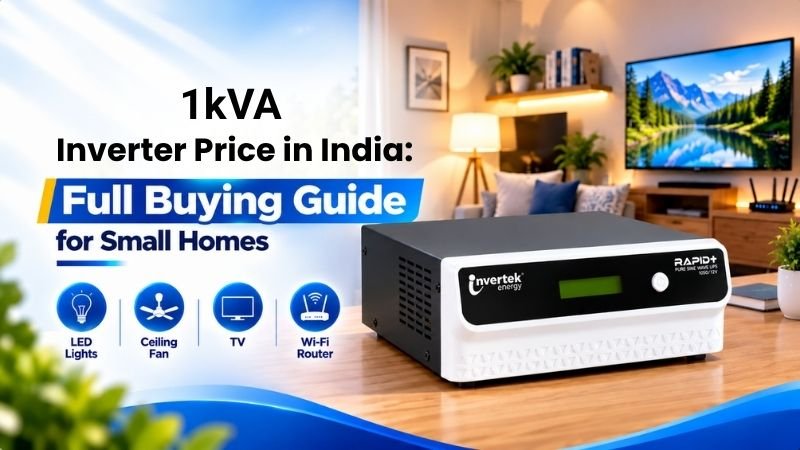
A 1kVA (1000 VA) inverter is one of the most popular choices for small homes and apartments in India. It sits right in the middle of the market, big enough to run a decent set of appliances, but not so large that you’re paying for capacity you’ll never use. Here’s what to expect price-wise in 2026 and how to know if it’s the right size for you.
Prices vary based on brand, waveform, and city, so treat this as a general range.
| Brand Type | Typical Price Range (Inverter Only) |
| Basic square wave, 1kVA | ₹5,000 – ₹7,000 |
| Pure sine wave, 1kVA (standard brands) | ₹7,000 – ₹10,500 |
| Pure sine wave, 1kVA (with fast charging) | ₹9,500 – ₹12,500 |
Add a battery to this and your total budget typically lands between ₹18,000 and ₹26,000 for a complete 1kVA setup with a 150Ah battery.
A 1kVA inverter can comfortably run:
It generally cannot run heavier appliances like a refrigerator, air conditioner, or a washing machine at the same time as the above. If your list of must-run appliances during a power cut includes any of these, you’ll likely need a higher capacity, such as 1.5kVA or 2kVA.
To check this properly before you buy, use the simple math in our guide on how to calculate your inverter battery backup time. It walks you through adding up your actual wattage needs so you don’t guess and end up with the wrong size.
Two 1kVA inverters can be priced very differently for these reasons:
Waveform. Pure sine wave costs more but is safer for electronics with motors or sensitive circuits, like fans and TVs.
Charging current. A higher amp rating charges your battery back up faster after an outage.
Display type. LCD screens showing load and battery percentage cost more than simple LED indicator lights.
Warranty length. Longer warranty periods, especially those covering both parts and labor, usually come with a slightly higher price.
Brand and service network. Established brands with wide service coverage often price a bit higher than newer or more direct-to-consumer manufacturers.
Since 1kVA is one of the most commonly sold capacities, competition among brands is high, and pricing gaps between big names and direct manufacturers can be wider here than in other categories. A manufacturer selling more directly, like Invertek, can often match the specification of a bigger brand’s 1kVA model at a lower price, since it isn’t carrying the same distribution and advertising overhead.
If you want to understand this pricing gap in more detail before you decide, our article on why buying direct from the manufacturer makes sense in India lays out exactly where that extra cost usually comes from.
A 1kVA inverter is a smart, budget-friendly choice for most small homes, as long as your appliance list matches what it can actually support. Confirm the waveform, check the charging speed, and compare at least two brands, including a direct-manufacturer option, before making your final decision.
1. What is a fair price for a 1kVA pure sine wave inverter?
A good pure sine wave 1kVA inverter typically costs between ₹7,000 and ₹10,500, not including the battery.
2. Can a 1kVA inverter run a refrigerator?
Most 1kVA inverters are not designed to comfortably run a refrigerator along with other appliances at the same time. Check the total wattage of everything you want to run before deciding.
3. What size battery pairs well with a 1kVA inverter?
A 100-150Ah tubular battery is a common pairing for a 1kVA inverter, depending on how many backup hours you want.
4. Is a 1kVA inverter enough for a 1BHK or small apartment?
Yes, for most 1BHK homes with basic lighting, fans, a TV, and a router, a 1kVA inverter is usually sufficient.
5. Is it worth paying more for a branded 1kVA inverter over a direct-manufacturer one?
Not necessarily. If the specification sheet (waveform, charging current, warranty) is similar, a direct-manufacturer model can offer the same performance at a lower cost.
Product Catalogues
Useful Links
Become a Partner
Support
Track your Order
Get In Touch

Secure Payment:

Sevenpeaks Solutions Online Ecom Distributor of Invertek Energy