


Once your power needs go beyond basic lights and fans, you’re usually choosing between a 2kVA vs 3kVA inverter. The price difference isn’t huge, but the wrong choice can mean either overspending on capacity you don’t use, or ending up with an inverter that trips every time you switch on too many appliances. Here’s how to decide.
| Capacity | Typical Price Range (Inverter Only) |
|---|---|
| 2kVA (24V, pure sine wave) | ₹13,000 – ₹19,000 |
| 3kVA (24V, pure sine wave) | ₹19,000 – ₹28,000 |
The battery cost adds on top of this. Since both capacities usually need two batteries (24V setup), expect to add anywhere from ₹16,000 to ₹32,000 depending on the Ah rating and battery type you choose. You can compare pure sine wave inverters across our range to see current pricing.
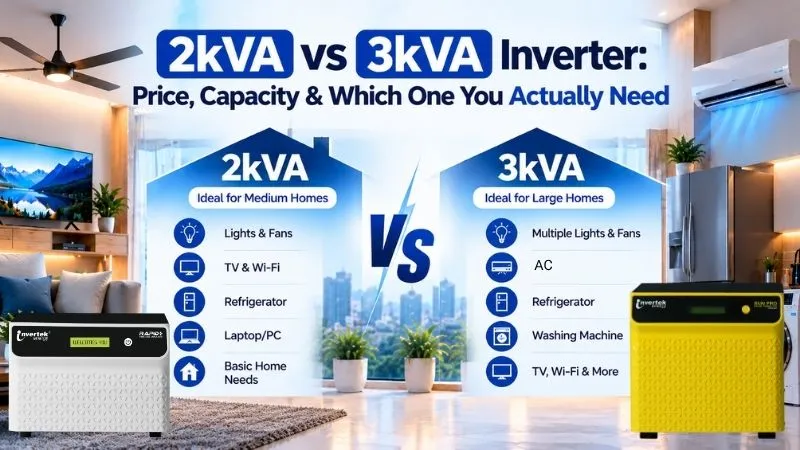
A 2kVA inverter can typically handle:
If this list matches your home, our home UPS and inverter range is the best place to start.
A 3kVA inverter adds headroom for:
For these heavier loads, look at our higher-capacity inverters.
If your home regularly runs a refrigerator plus a few other heavier appliances at the same time during a power cut, 3kVA gives you more breathing room. If your needs are closer to the 2kVA list, there’s no benefit in paying extra for capacity you won’t use.
For a full walkthrough of this calculation, including how it affects your backup hours, see our guide on how to calculate your inverter battery backup time.
A 3kVA setup generally uses two batteries instead of one, since it typically runs on 24V. This means:
If space is tight, a lithium wall-mounted UPS can be easier to place than a conventional inverter with separate batteries. For conventional setups, tall tubular batteries are the most common choice, and gel batteries are an option if you want a different battery type.
If you want to reduce your dependence on grid charging, a solar hybrid PCU is worth considering.
If your appliance list genuinely needs 3kVA, this extra cost is worthwhile. If it doesn’t, a 2kVA setup with a single reliable battery is simpler and cheaper to maintain.
Neither capacity is inherently “better value” than the other. It depends entirely on matching the inverter to your real household load. Overbuying wastes money on unused capacity, while underbuying leads to constant tripping and frustration.
Once you know your number, compare prices across a few brands, including direct-manufacturer options like our premium home UPS series, for the best deal at that specific capacity.
Choose 2kVA if your home runs lights, fans, a TV, and a moderate refrigerator. Choose 3kVA if you need to add an AC, washing machine, or run several heavier appliances together.
Calculate your actual load first, then shop for the best price at that capacity rather than guessing based on budget alone. Once installed, a Service Care Pack helps keep your inverter and battery running reliably.
👉 Get a capacity recommendation: use our UPS Finder to confirm whether 2kVA or 3kVA fits your home, or contact our team.
1. Can a 2kVA inverter run an air conditioner?
Generally no. Most window and split ACs need at least 3kVA or higher due to startup surge, though this depends on the exact AC model and wattage.
2. How many batteries does a 3kVA inverter need?
Most 3kVA inverters run on a 24V setup, requiring two batteries connected in series.
3. Is the price difference between 2kVA and 3kVA significant?
The inverter price difference is usually ₹5,000 to ₹9,000, but factoring in the extra battery for a 3kVA setup, the total cost difference can be higher.
4. What size battery works best with a 2kVA inverter?
A single 150-160Ah tubular battery is a common choice for a 2kVA inverter, depending on your desired backup time.
5. Should I buy 3kVA now in case my needs grow later?
Only if you have a specific plan for the extra load, like adding an AC soon. Otherwise, it’s more cost-effective to buy the capacity you need now and upgrade later if your requirements genuinely change.
Product Catalogues
Useful Links
Become a Partner
Support
Track your Order
Get In Touch

Secure Payment:


Sevenpeaks Solutions Online Ecom Distributor of Invertek Energy