
Search “top inverter brands in India” and you’ll find dozens of lists ranking brands from one to ten. Most of them just repeat the same names without explaining why one brand might suit you better than another. Instead of another ranked list, this guide gives you the actual criteria to compare brands yourself, so you can make a confident choice no matter which names you’re considering.
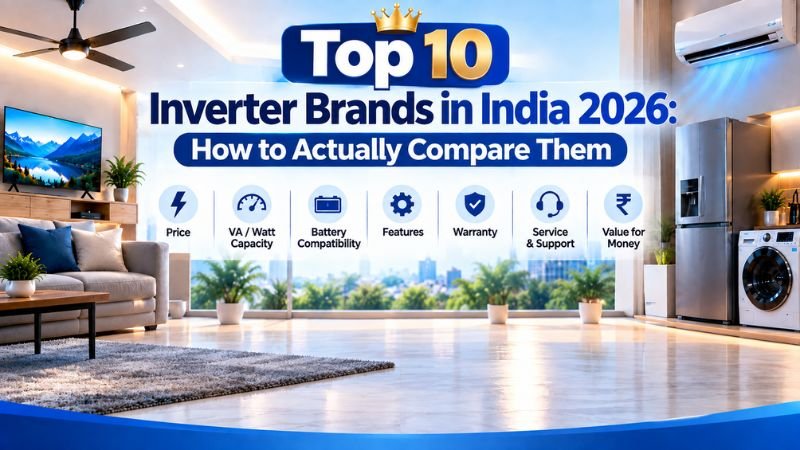
When comparing any inverter brand, whether it’s a household name or a newer manufacturer, judge it against these five things:
Look at the transformer type (copper windings generally outperform lower-grade materials), the sturdiness of the casing, and how well the unit handles heat during continuous use. Brands that publish clear technical specifications are usually more transparent about build quality.
Pure sine wave output should be the baseline expectation today, not a premium feature. Confirm this on the specification sheet rather than assuming based on price alone.
A longer warranty is only valuable if it’s backed by an accessible service network. Check whether the warranty covers parts and labor, or parts only, and how easy it is to actually claim it.
This matters more than most buyers realize. A brand with a large service network means faster repairs and less downtime if something goes wrong. Ask your dealer how far the nearest service center is before you buy.
Established brands often carry the cost of national advertising and multiple layers of distributors and retailers. Manufacturers who sell more directly can offer similar specifications at a more competitive price, since fewer margins are built into the cost.
Most top brands, regardless of name, fall into these product categories:
Rather than picking a brand first, decide which category fits your actual need, then compare brands within that category.
When you have two options in front of you, run through this checklist:
If all of these match closely but the price differs significantly, the cheaper option, especially from a direct manufacturer, may simply be avoiding extra distribution costs rather than cutting corners on quality.
A growing number of buyers are looking beyond the traditional big names, choosing manufacturer who sell more directly and focus spending on the product itself rather than large-scale advertising. This can mean a comparable or better specification sheet for a more reasonable price, along with more direct access to the manufacturer for support.
Invertek is one such manufacturer, offering pure sine wave inverters, solar-hybrid models, and home UPS systems built to match or exceed the specifications common among the bigger, more heavily marketed brands. If you’d like to understand this comparison in more depth, our article on why buying direct from the manufacturer makes sense in India covers exactly what to look for.
Instead of chasing a “top 10” ranking, focus on the criteria that actually affect your day-to-day experience: build quality, waveform, warranty, service access, and fair pricing. Once you know what to look for, comparing any two brands, big or small, becomes a much simpler decision.
👉 See where Invertek fits and request a quote
1. Is a more expensive inverter brand always better quality?
Not necessarily. Price often reflects marketing and distribution costs as much as product quality. Compare the actual specification sheet before assuming a higher price means better performance.
2. What is the most important spec to check when comparing brands?
Waveform type (pure sine wave vs. square wave) has the biggest impact on how safely and smoothly your appliances run, so it’s a good starting point for comparison.
3. Are direct-manufacturer inverter brands reliable?
Many are, especially those with clear technical specifications, transparent warranty terms, and an accessible service or support process. Always check these details regardless of brand size.
4. How important is the service network when choosing a brand?
Very important. A wide service network means faster repairs and less downtime if your inverter or battery needs attention.
5. Should I always choose the brand with the longest warranty?
A longer warranty is valuable only if it’s easy to claim and backed by reliable service. Check the terms and the brand’s service accessibility, not just the number of years.
Product Catalogues
Useful Links
Support
Track your Order
Sevenpeaks Solutions Online Ecom Distributor of Invertek Energy